They’re and Their and There

They’re is a contraction joining they and are. The apostrophe has nothing to do with a possessive, but simply takes the place of the missing “a” when you combine the two words (such as didn’t, which of course is did + not).

So if you can write they are for a situation, then you can write they’re instead.

Their means belonging to them, whoever they are. Their friends, their boots, their thoughts. We can never say they are boots unless you are calling those people boots. If they own boots, we would say their boots.

There used to be spelled correctly almost all of the time. Now it’s in the same danger as those other two words that sound like it. There indicates a direction: “I put it over there, next to the couch.” But you already knew that.

Note: Next Tuesday is July 4, and a holiday. So the next entry after today will be on July 11. Happy Independence Day!
Words to Never Say, Part Three

One phrase that should rarely if ever escape our lips is the ubiquitous “no problem.” I know that I am not the only one driven crazy by that. It’s somehow become synonymous with “You’re welcome.” It doesn’t mean that, and yes, that’s a problem.

Chick-fil-A employees have this down. They say, “My pleasure” or some version of that. That’s a kind and gracious way of saying, “You’re welcome.” Saying “no problem” is just the opposite.

Saying “No problem” implies that your serving someone is indeed an imposition, but that you have overcome this difficulty and appear to be gracious enough to dismiss the incredible hard work you did to provide the service. When someone says “No problem,” it implies that you have asked someone to do something out of the ordinary, and one that poses “a problem.” If you’re providing a normal service in a normal service situation, you should say, “You’re welcome” or something equally as gracious.

If you have been presented with a challenging task that is unanticipated, and you have gone WAY out of your way to do something that wasn’t expected of you, then you could say, “No problem” to an expression of gratitude and be seen as gracious. But when you give me my coffee and I say, “Thank you,” I’m assuming that it wasn’t a major issue or challenge to give it to me. Answering “No problem” implies that.

So don’t say it. Strike it from your vocabulary.

Can I get an Amen, somebody?!

Literally and Figuratively

We live in an age of exaggeration, and these two wonderful words have been two of the victims. Let’s do what we can to bring a measure of reason and exactness to them.

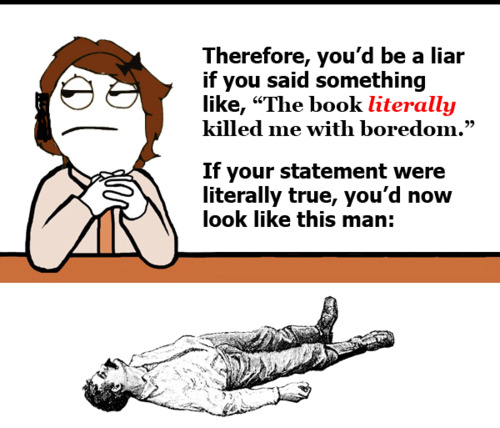
Literally means actually. Not like, not similar to, not as if, but actually. If something literally happened, then it really did happen in space and time.

Figuratively means that something was like something else, that it was “as if” something were like something else, but in actuality, was not. We use the word to create a comparison.

If something literally cost you an arm and a leg, that is both criminal and painful. If you say that it did, we should all know that you are speaking figuratively (we hope).

If something literally blew you away, then you ended up, due to high winds or an explosion of some sort, in a difference place from where you began.

If you were literally broke, that means that you have no money. Not a sou. Not a dime. Not a penny.

What we need to do is gently and slowly bring back the word figuratively into our speech, or at least into our written expressions. Or better still, let’s simply drop the word literally from our speech and writing altogether, because most of the time, we mean figuratively anyway!